Launch offer — valid today only

📄 Digital book in PDF · read it on your phone or print it

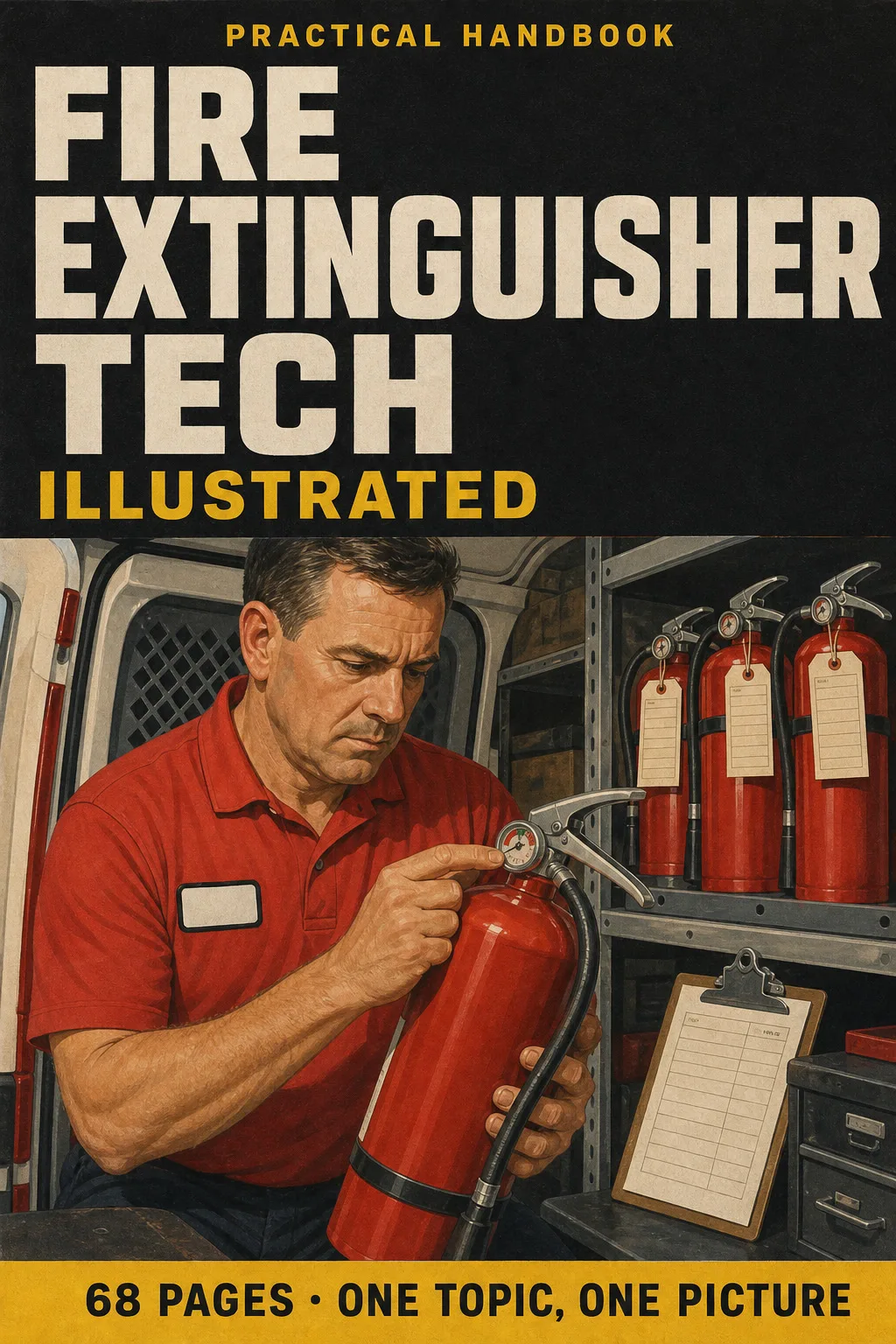
Portable Extinguisher Service and NFPA 10 in Drawings Know What's Due on Any Unit, Page by Page

Fire classes, agents, the exploded view, gauge zones, the monthly inspection, 6-year maintenance, hydro intervals, service tags and placement. Each topic gets its own page: the drawing first, then what you need to remember. 68 illustrated pages.

START STUDYING THIS WAY

🔒 Secure checkout · PDF by email · 30-day guarantee

Every topic, its own pageEvery part and every interval drawn, with the explanation right beside it
68 illustrated pages8 parts, from the fire tetrahedron to the most common exam mix-ups
Up-to-date sourcesNFPA 10, plus state license rules for California, Texas and Florida
PDF by emailFormat

Look Inside the Book

Every page has one big drawing and a box with the intervals, ratings and steps you need to know:

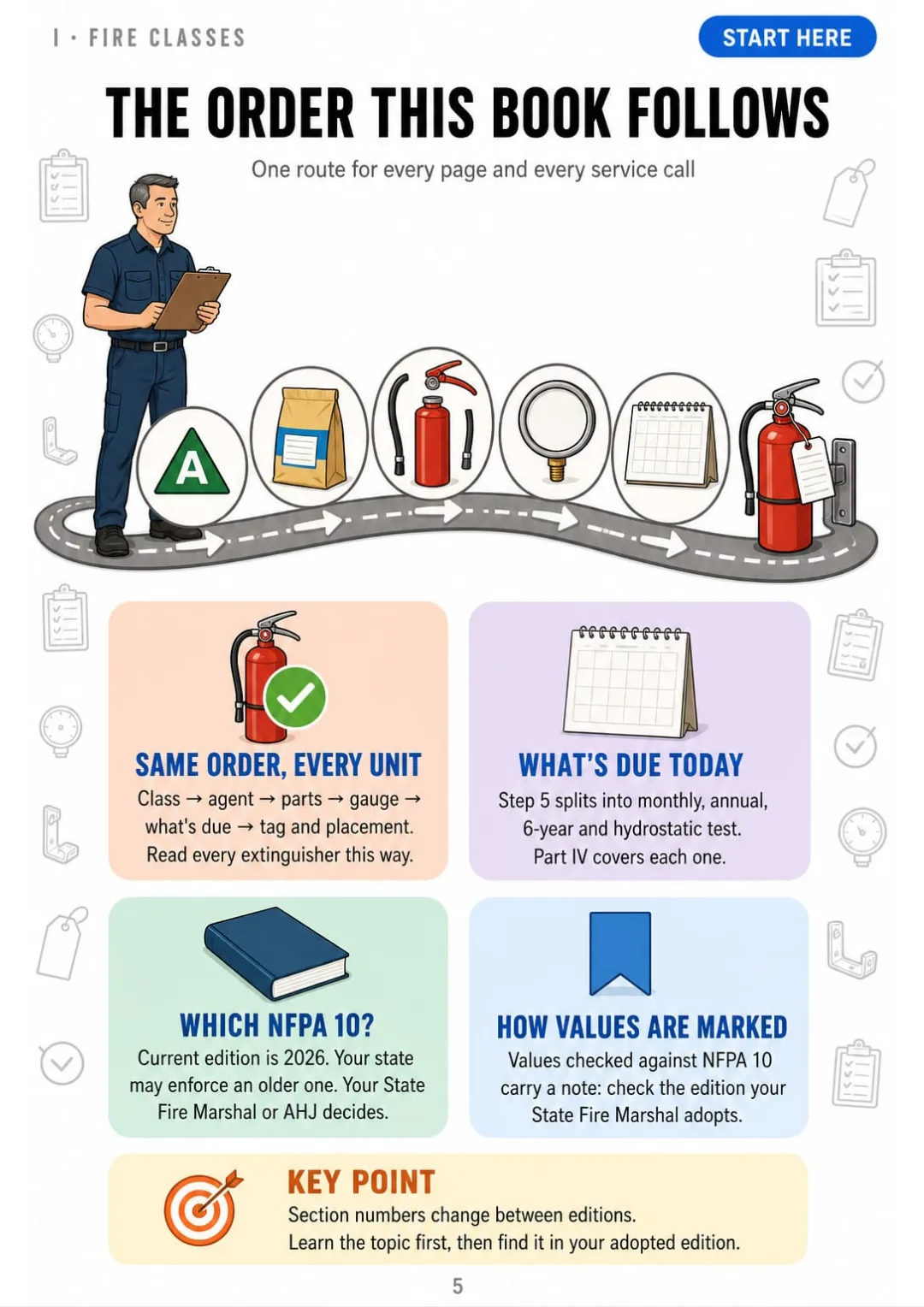
Class → agent → parts → gauge → what's due → tag: one route for every unit
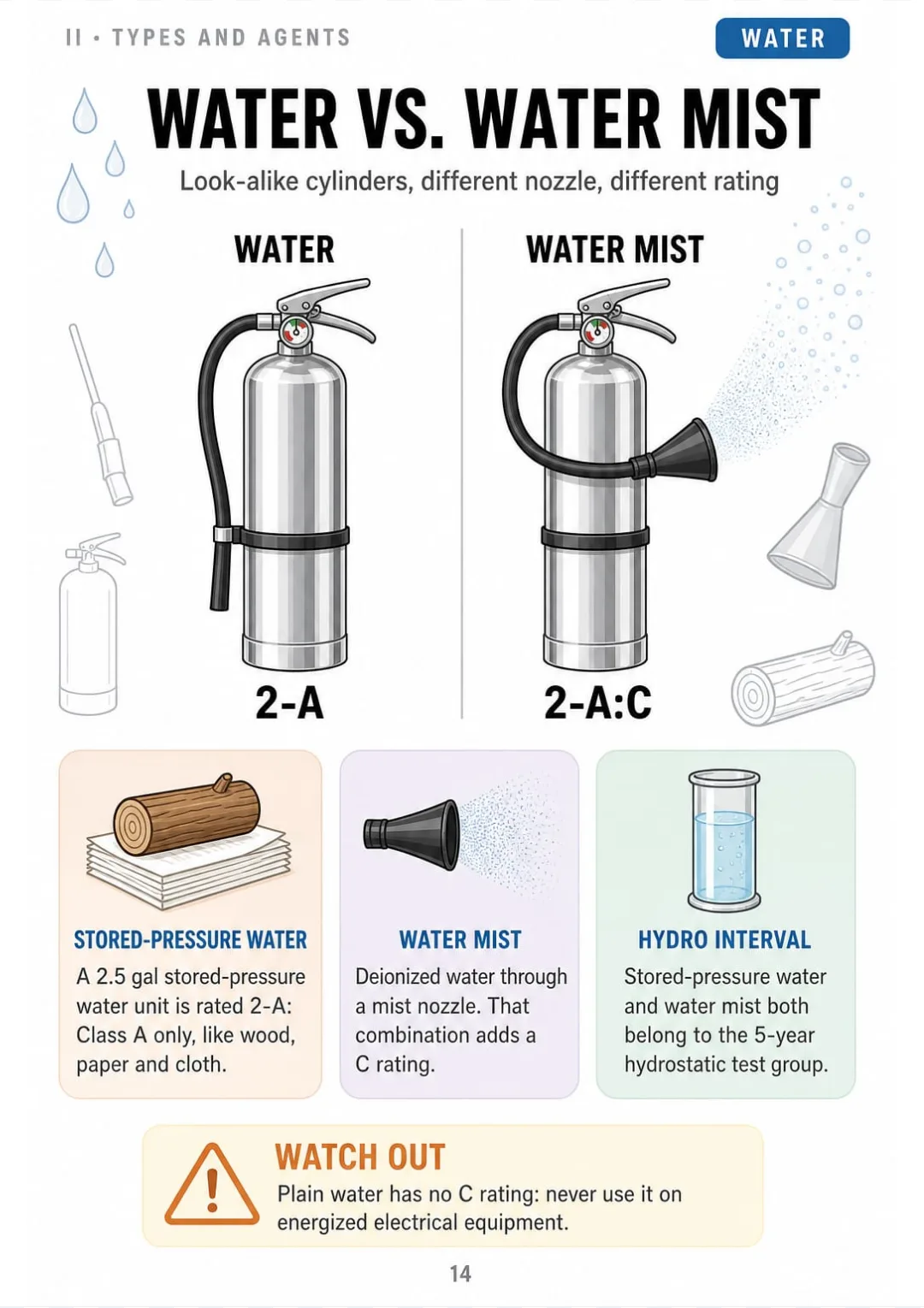
Water: 2-A, Class A only. Water mist: deionized water + mist nozzle = adds C.
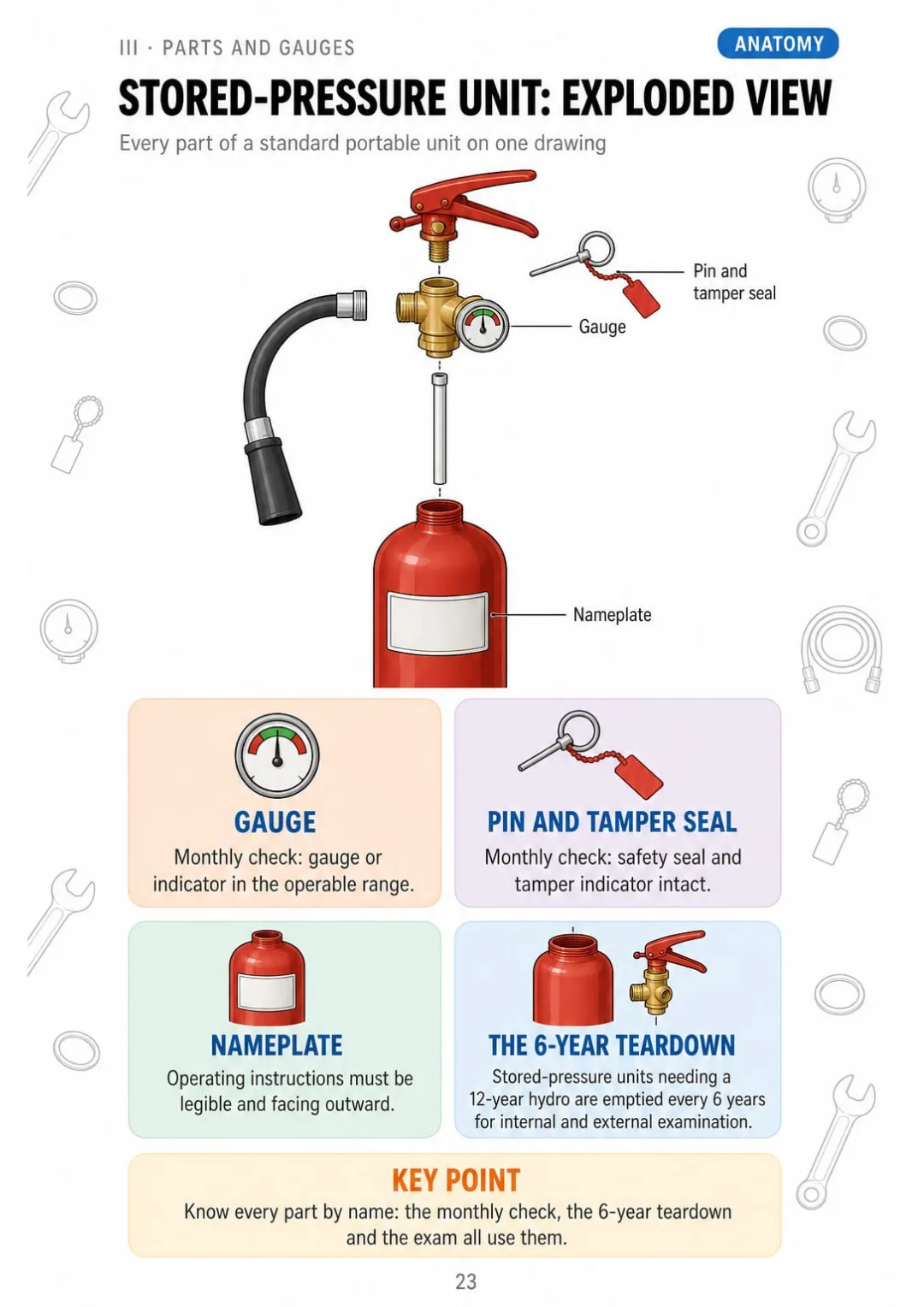
13 parts of a stored-pressure extinguisher, labeled on one exploded view
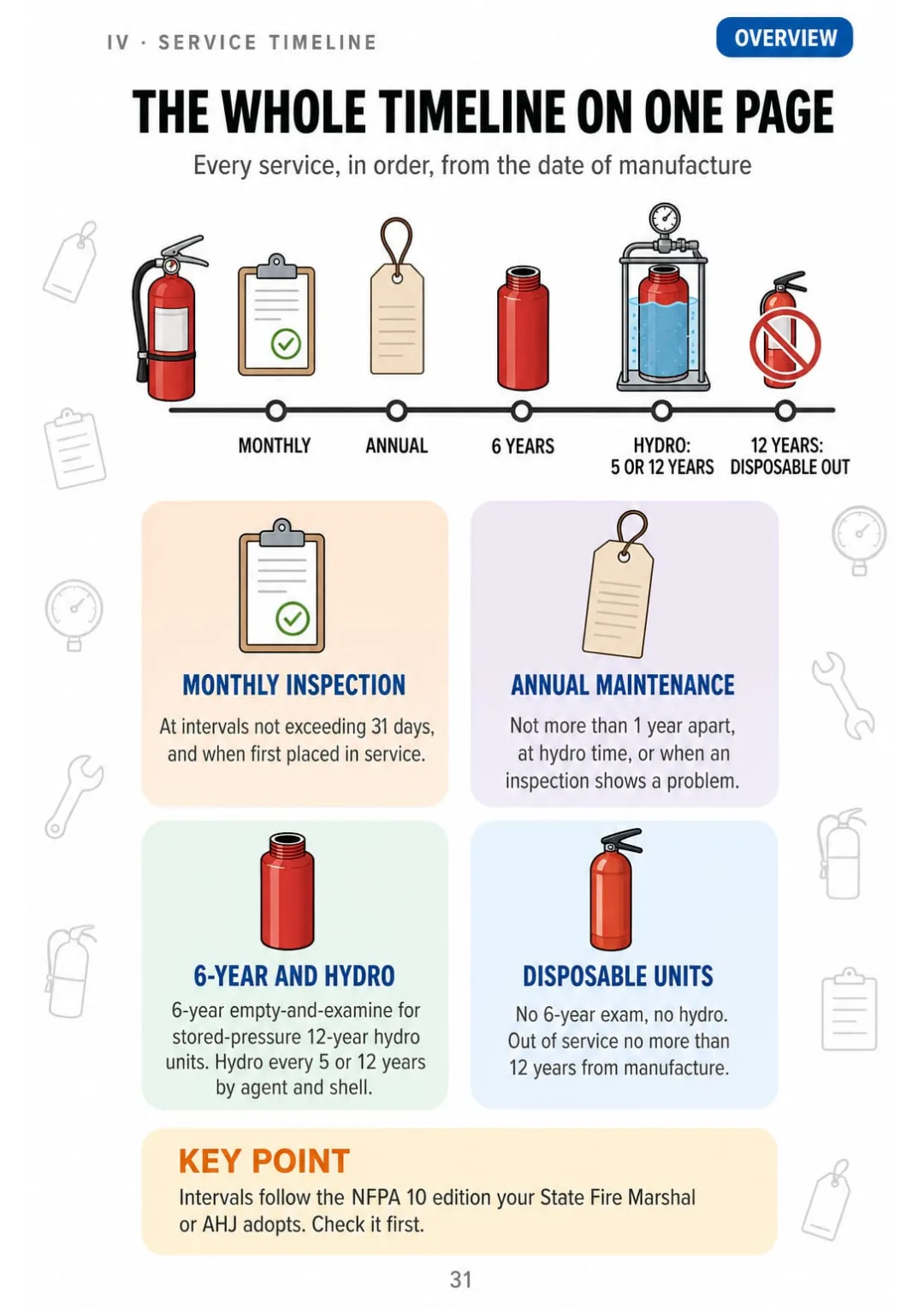
31 days · 1 year · 6 years · hydro at 5 or 12 years, all on one line
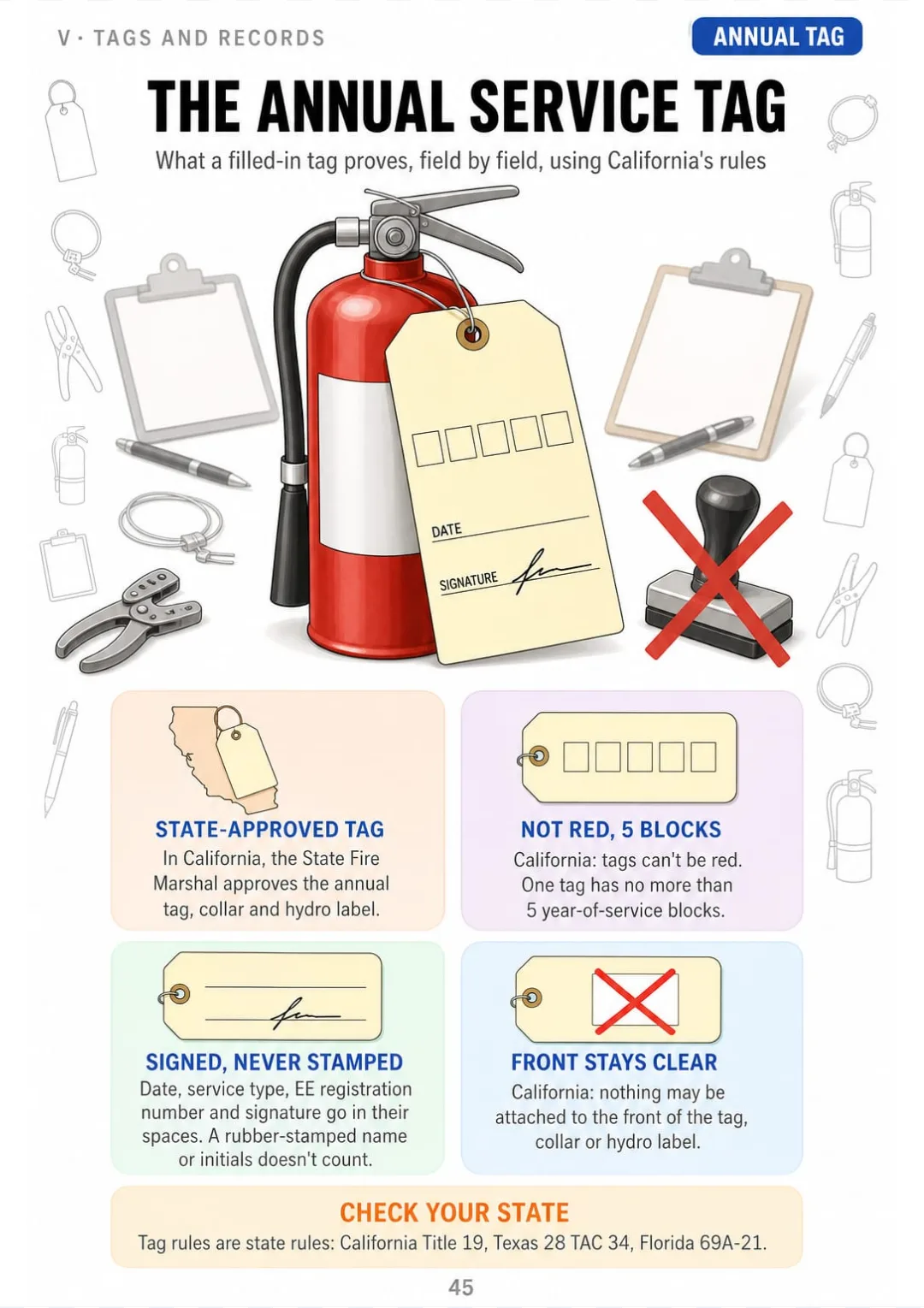
California: tag not red, max 5 year blocks, signature and registration number written in, never rubber-stamped.
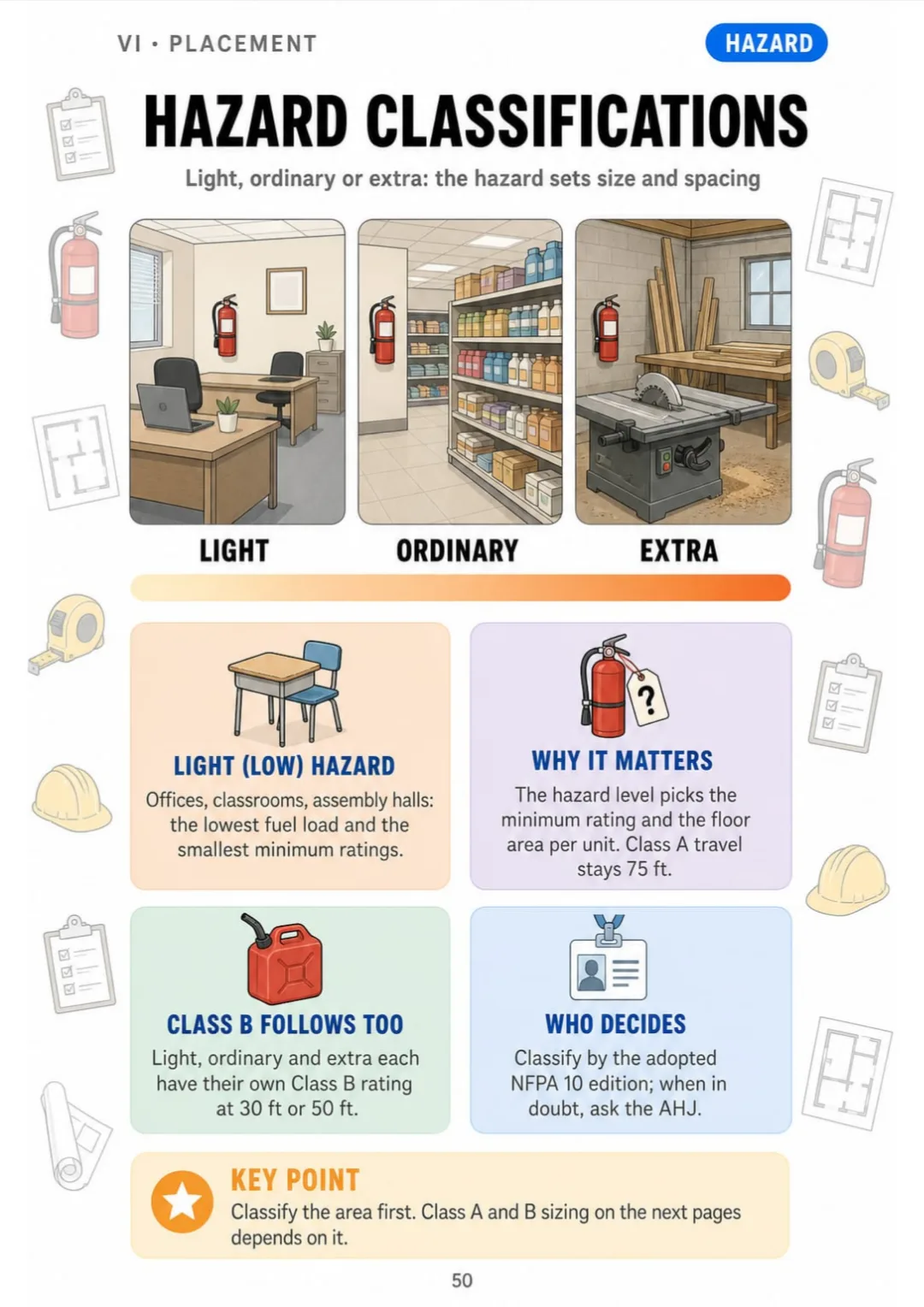
Light, ordinary, extra: three hazard levels that set every extinguisher rating and distance
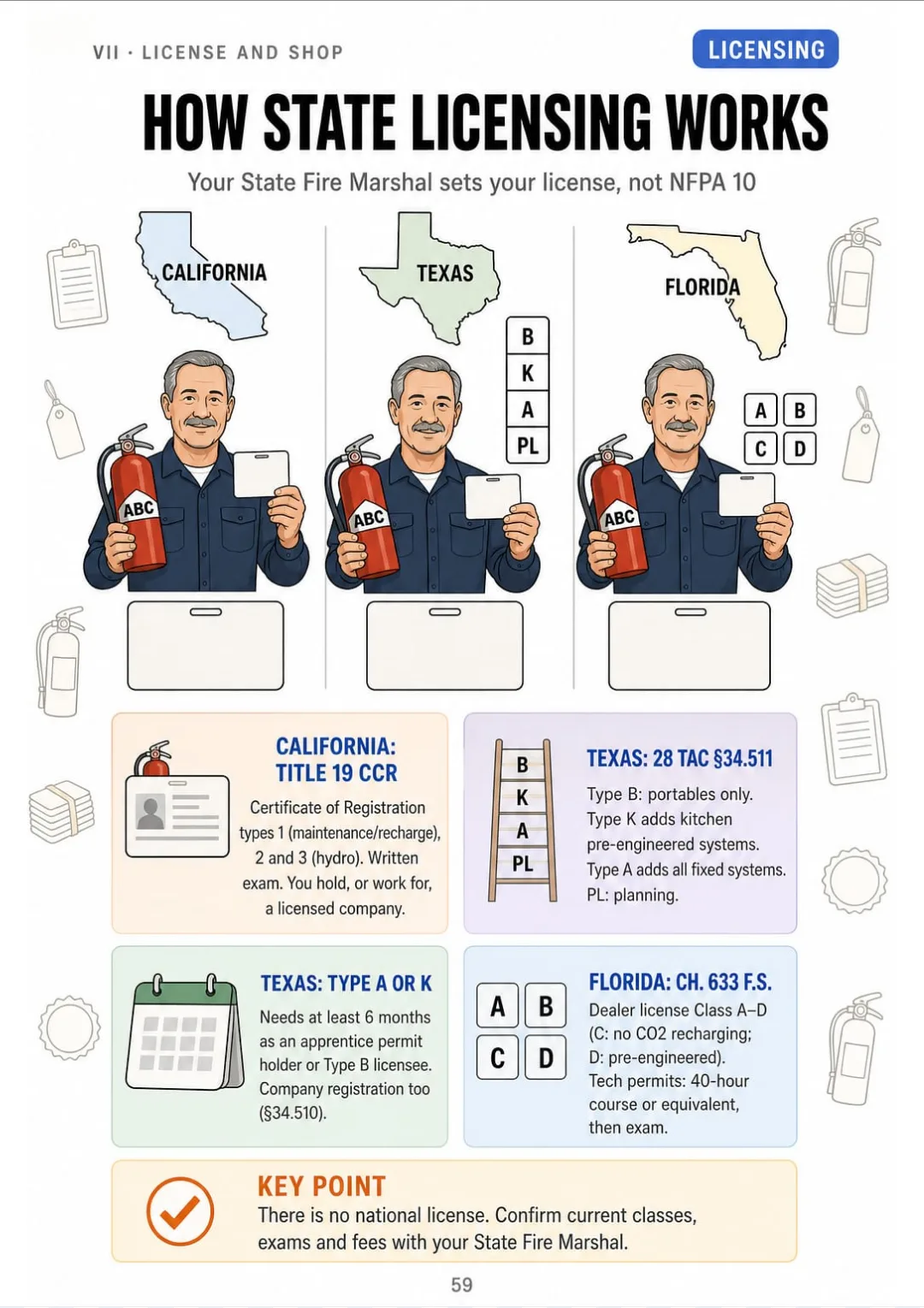
Texas Type B, K, A, PL vs. California Certificate of Registration vs. Florida Class A–D.
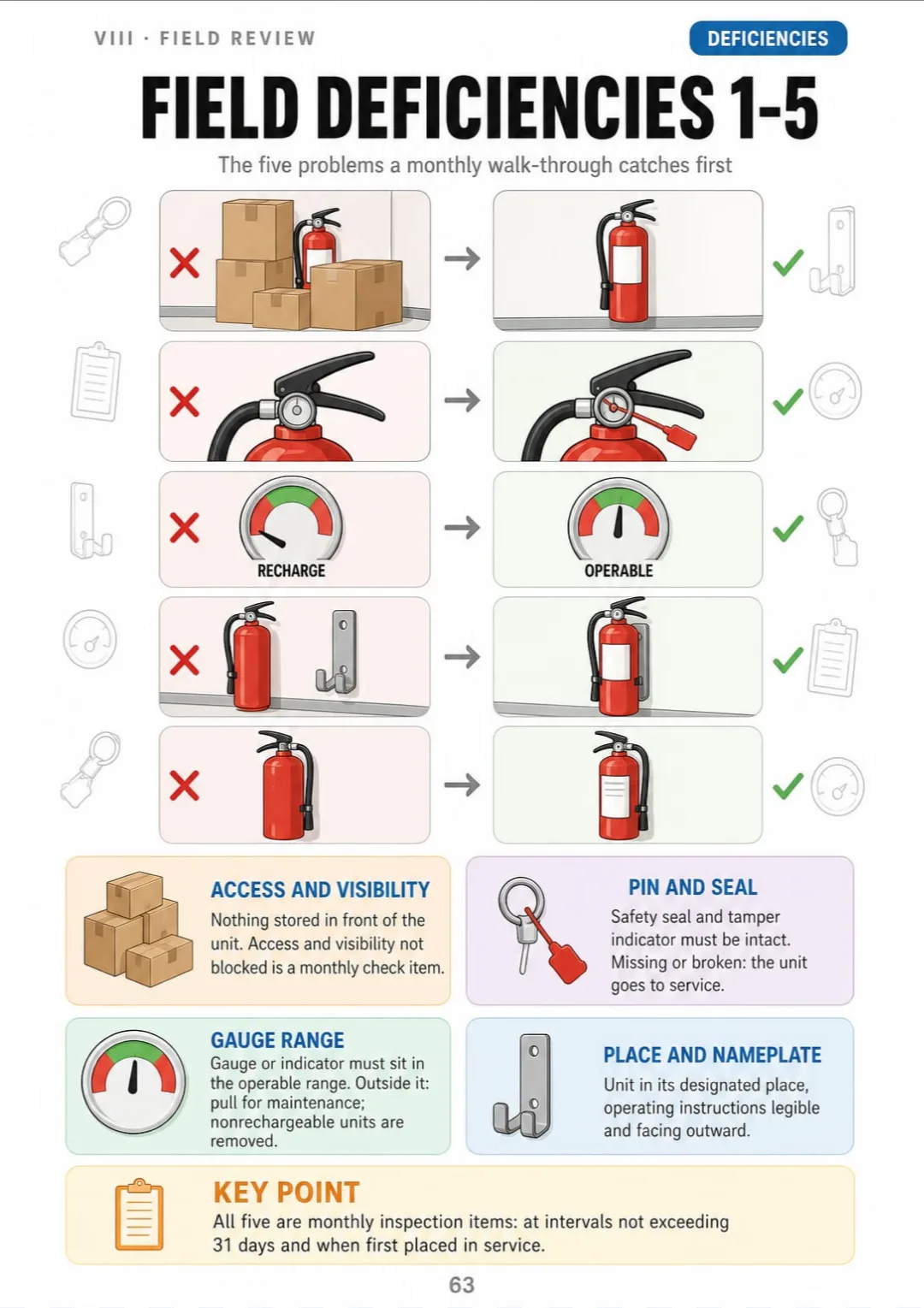
Blocked, no seal, low gauge, off the hanger, nameplate to the wall: five fixes drawn

Swipe to see more →

These are real pages from the book. The table of contents is the full one: 8 parts and 64 topics.

The Problem Isn't You. It's How It Was Explained to You.

You're at the bench with a stored-pressure ABC unit, and the shop lead asks you to name what's inside before you break it down.

The manual covers it in paragraphs: valve body, stem, spring, O-ring, siphon tube. Read as text, thirteen parts turn into one long list.

13 parts of a stored-pressure extinguisher, labeled on one exploded view

In the book, that same unit is one exploded view: 13 parts pulled apart and labeled, from the pin and tamper seal up top to the siphon tube inside the shell.

The gauge and its three zones, the nameplate, the service timeline, the annual tag and the hydro label get the same treatment: each one has its own page.

You see how the unit goes together, and you break it down without going back to the manual.

COMPARE FOR YOURSELF

The Same Topic, Two Ways to Study It

THIS
  • The manual: line after line
  • Agents and fire classes explained only in words
  • You walk into the exam still unsure
Extinguishers utilizing plain water as the extinguishing agent are listed for use on Class A fires only and are commonly rated 2-A. Such units shall not be employed on energized electrical equipment, owing to the conductivity of the discharge stream. Water mist extinguishers, by contrast, utilize deionized water discharged through a specially designed mist nozzle, the combination of which reduces conductivity and permits a Class C rating in addition to the Class A rating, subject to the manufacturer's listing and the applicable edition of the standard.
FOR THIS
  • Water vs. water mist in one drawing
  • One box: water 2-A, water mist 2-A:C
  • Why mist can go near energized equipment, drawn
Water: 2-A, Class A only. Water mist: deionized water + mist nozzle = adds C.
CONTENTS

Take a Look at the 8 Parts and 64 Topics

Fire classes, extinguisher types and agents, parts and gauges, the service timeline, tags and records, selection and placement, license and shop, and field review: 68 pages, all illustrated.

IFire Classes · pp. 5-13
  1. The Order This Book Follows
  2. The Fire Tetrahedron
  3. Class A: Ordinary Combustibles
  4. Class B: Flammable Liquids and Gases
  5. Class C: Energized Electrical
  6. Class D: Combustible Metals
  7. Class K: Cooking Oils and Fats
  8. Letter Symbols vs. Pictograms
  9. Reading a Rating: 2-A:10-B:C
IIExtinguisher Types and Agents · pp. 14-22
  1. Water and Water Mist
  2. Foam: AFFF and FFFP
  3. Carbon Dioxide (CO2)
  4. ABC Dry Chemical
  5. BC Dry Chemical: Sodium Bicarb and Purple K
  6. Wet Chemical (Class K)
  7. Clean Agents
  8. Class D Dry Powder
  9. Never Mix Dry Chemical Agents
IIIParts and Gauges · pp. 23-30
  1. Stored-Pressure Unit: Exploded View
  2. Cartridge-Operated Unit
  3. CO2 Unit Anatomy
  4. Reading the Nameplate
  5. The Gauge: Three Zones
  6. Matching Gauge to Unit
  7. Pin, Tamper Seal and Indicators
  8. Hoses, Nozzles and Horns
IVWhat's Due Today: The Service Timeline · pp. 31-44
  1. The Whole Timeline on One Page
  2. Monthly Inspection: The Checklist
  3. Inspection vs. Maintenance vs. Testing
  4. Annual Maintenance
  5. 6-Year Maintenance
  6. Which Units Get the 6-Year
  7. Hydrostatic Testing: What It Proves
  8. The 5-Year Hydro Group
  9. The 12-Year Hydro Group
  10. DOT Cylinders vs. Non-DOT Shells
  11. CO2: Weigh, Don't Guess
  12. Recharge After Use
  13. Obsolete Units: Remove From Service
  14. Condemning a Shell
VTags, Collars and Records · pp. 45-49
  1. The Annual Service Tag
  2. The Verification-of-Service Collar
  3. The Hydro Label
  4. Reading a Unit in 10 Seconds
  5. Records That Hold Up
VISelection and Placement · pp. 50-58
  1. Hazard Classifications
  2. Class A Sizing
  3. Class B Sizing and Travel Distance
  4. Class C Placement
  5. Class K in Commercial Kitchens
  6. Class D Placement
  7. Mounting Height and Clearance
  8. Visibility, Cabinets and Signs
  9. P.A.S.S. and Basic User Training
VIILicense and Shop · pp. 59-62
  1. How State Licensing Works
  2. What the Exam Usually Covers
  3. Finding Your Way Around NFPA 10
  4. Shop Safety: Pressure and Nitrogen
VIIIField Review · pp. 63-68
  1. Common Field Deficiencies 1–5: Before/After
  2. Common Field Deficiencies 6–10: Before/After
  3. Common Field Deficiencies 11–15: Before/After
  4. Pass or Pull: The Decision Flow
  5. The Numbers on One Page
  6. Most Common Exam Mix-Ups

One Page, One Topic, All Clear

Think of it this way:

You're in a warehouse aisle with a 20-pound ABC unit. The gauge is in the green, the hydro stamp is old, and the customer wants to know if it's good.

You open the timeline page and it's drawn on one line: 30 days, 1 year, 6 years, hydro at 5 or 12, with the ABC unit sitting in the 12-year group.

California: tag not red, max 5 year blocks, signature and registration number written in, never rubber-stamped.

Same with the gauge zones, the exploded view, hazard classifications, the annual tag and the field deficiencies: each one on its own page.

Fire Extinguisher Tech Illustrated is 8 parts and 64 topics, all drawn, and it ends with the numbers on one page and the most common exam mix-ups.

What you see drawn, you don't have to memorize.

What's Inside Fire Extinguisher Tech Illustrated:

Ipp. 5-13

Fire Classes

The order the book follows, the fire tetrahedron, Classes A, B, C, D and K, letter symbols vs. pictograms and how to read a rating like 2-A:10-B:C.

IIpp. 14-22

Extinguisher Types and Agents

Water and water mist, AFFF and FFFP foam, CO2, ABC and BC dry chemical, wet chemical, clean agents, Class D powder and why dry chemicals are never mixed.

IIIpp. 23-30

Parts and Gauges

The stored-pressure unit in an exploded view, cartridge-operated and CO2 units, the nameplate, the gauge's three zones, pin, tamper seal, hoses and horns.

IVpp. 31-44

What's Due Today: The Service Timeline

The whole timeline on one page, the monthly checklist, annual and 6-year maintenance, the 5- and 12-year hydro groups, DOT cylinders, weighing CO2, recharge, obsolete units and condemned shells.

Vpp. 45-49

Tags, Collars and Records

The annual service tag, the verification-of-service collar, the hydro label, reading a unit in 10 seconds and records that hold up.

VIpp. 50-58

Selection and Placement

Hazard classifications, Class A and B sizing, travel distance, Class C, K and D placement, mounting height, clearance, cabinets, signs and P.A.S.S. training.

VIIpp. 59-62

License and Shop

How state licensing works, the topics listed in state exam outlines, finding your way around NFPA 10 and shop safety with pressure and nitrogen.

VIIIpp. 63-68

Field Review

15 common field deficiencies drawn before and after, the pass-or-pull decision flow, the numbers on one page and the most common exam mix-ups.

At the end of the book: 15 field deficiencies drawn before/after, a pass-or-pull decision flow and all the numbers on one page.
Plus: 2 Free Books

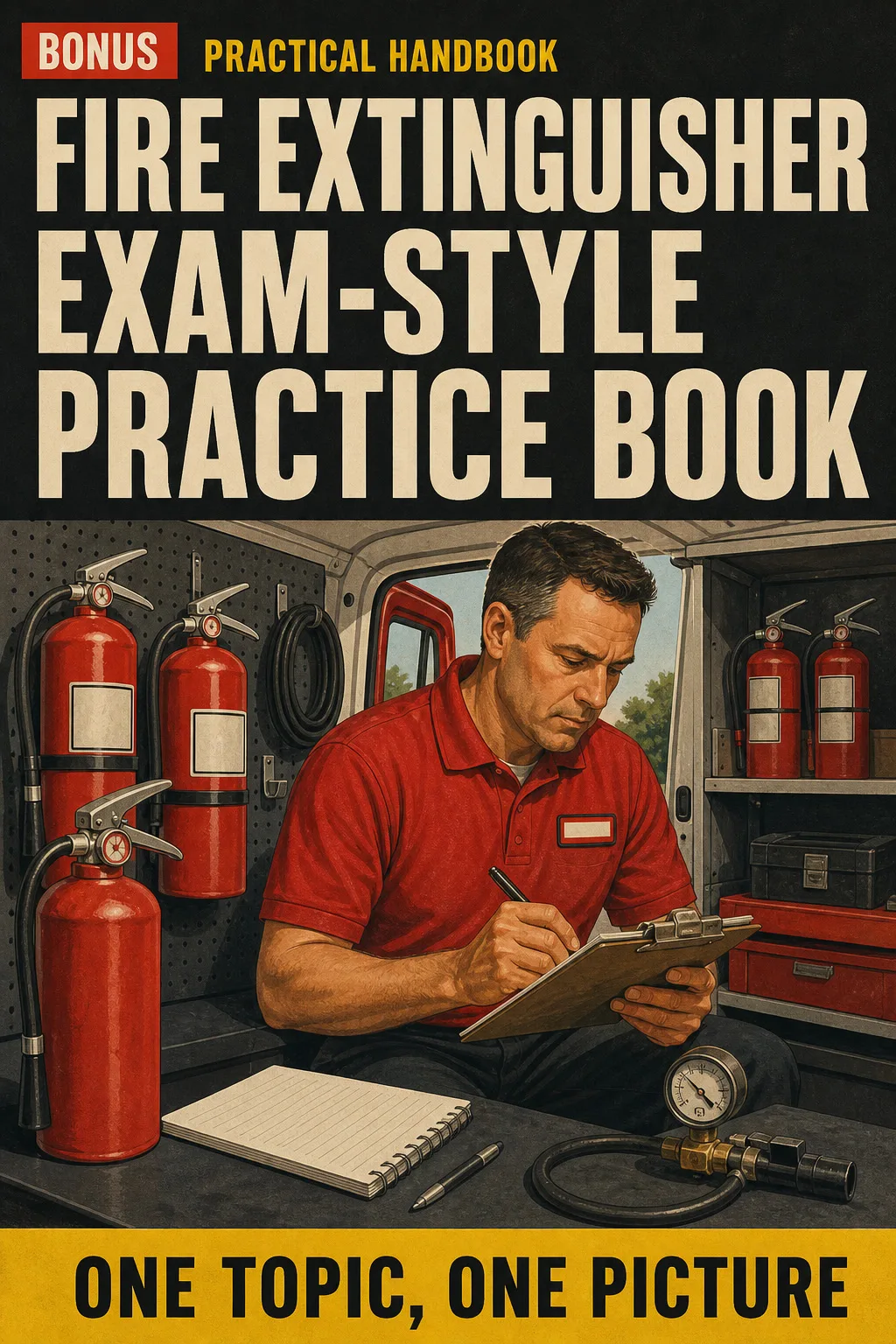
Fire Extinguisher Exam-Style Practice Book

BONUS 1: «Fire Extinguisher Exam-Style Practice Book»

Value on its own: US$ 17.90

Exam-style questions with the answer explained and the page to review, so you find your gaps before test day, not during it.

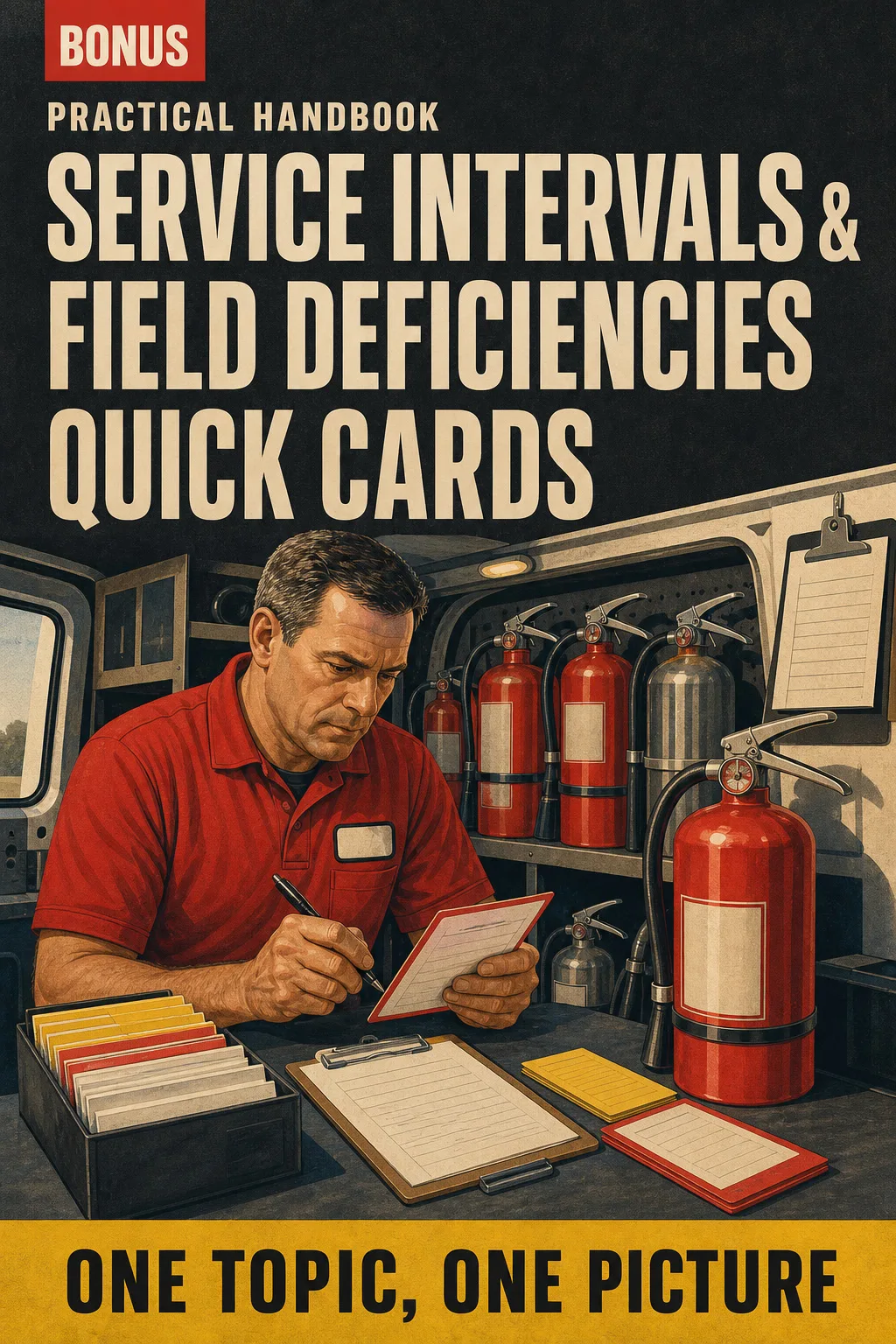
Service Intervals & Field Deficiencies Quick Cards

BONUS 2: «Service Intervals & Field Deficiencies Quick Cards»

Value on its own: US$ 14.90

Every inspection, maintenance and hydro interval plus the most common field deficiencies on printable cards you can review in minutes or keep in the truck.

Fire Extinguisher Tech Illustrated with 2 Free Books

  • Fire Extinguisher Tech Illustrated: 68 illustrated pagesUS$ 63
  • BONUS 1: Fire Extinguisher Exam-Style Practice BookUS$ 17.90
  • BONUS 2: Service Intervals & Field Deficiencies Quick CardsUS$ 14.90
  • High-resolution PDF to printIncluded
Total value US$ 95.80
YOUR PRICE:
US$ 27
You save US$ 68.80
YES, I WANT FIRE EXTINGUISHER TECH ILLUSTRATED FOR US$ 27

📄 This is a digital PDF book sent to your email: nothing is printed or shipped.

Secure purchaseEncrypted payment30-day guarantee

PDF by email: We email you Fire Extinguisher Tech Illustrated as a PDF, together with the two free books. It's a single payment: no installments, no extra charges.

Who This Book Is For

You're new to fire protection

You're new to fire protection

Coming from HVAC, maintenance or handyman work, you get the whole service in one sequence: class, agent, parts, gauge, what's due, tag.

Your license exam is coming up

Your license exam is coming up

You review the intervals, ratings and placement rules in the same order every time, and the practice book shows you the gaps before test day.

You already service extinguishers

You already service extinguishers

The timeline, the hydro groups and the field deficiencies are drawn on pages you can print and keep in the truck for the next call.

Everything You Get Today

US$ 95.80US$ 27
YES, I WANT FIRE EXTINGUISHER TECH ILLUSTRATED FOR US$ 27

📄 This is a digital PDF book sent to your email: nothing is printed or shipped.

30DAYS
GUARANTEE

30-Day Guarantee

Try Fire Extinguisher Tech Illustrated for 30 days, bonus books included.

We refund everything if the file won't open, if the book isn't what you see here, if you were charged twice or if the email doesn't arrive. Just email us.

You pay once. No subscriptions.

Frequently Asked Questions

Is this for me if I'm moving into fire protection or studying for my state extinguisher license?

Yes. It covers portable extinguisher service from fire classes to tags and placement, in the order you work. It starts from the basics and goes all the way to hydro groups and field deficiencies. State rules differ: the book follows NFPA 10, compares licensing in California, Texas and Florida, and flags what to confirm with your State Fire Marshal.

Where does the content come from?

From NFPA 10, Standard for Portable Fire Extinguishers, which is the base of state extinguisher licensing. The intervals, ratings, heights and distances follow NFPA 10, and the book marks every number you should check against the edition your state adopted. State-specific pages (license types, the annual tag) cover California, Texas and Florida. In another state, the NFPA 10 core is the same, but check your State Fire Marshal's rules for license types and tag requirements.

Is this official material?

No. It's an independent illustrated study book. It's not published or endorsed by the NFPA or by any State Fire Marshal, and it doesn't give a certificate, a license or continuing-education hours. Your license comes only from your state's exam and requirements.

Does it replace my training or course?

No. It doesn't replace your employer's training, manufacturer service manuals or your state's requirements. It helps you review all of it in one order.

Are the practice questions the ones on the exam?

No. They're written for this book, in exam style, with the answer explained and the page to review.

When and how do I get it?

The book and the 2 bonus books arrive as PDFs by email, at the address you enter at checkout.

Do I have to pay every month?

No. It's a one-time payment. No subscription.

Can I get it on paper?

It's a PDF, so you can print it at home or at a print shop and keep it in the truck.

How does the refund work?

You have 30 days. We refund everything if the file won't open, if the book isn't what you see on this page, if you were charged twice or if the email doesn't arrive: just email us.

Before You Close This Page

No more rereading NFPA 10 with nothing sticking.

The 6-year and the hydro: you see them drawn, and they stick.

You walk into the exam knowing where everything is.

Drawings make studying faster.

The book is right below.

One-time payment: US$ 27 · Guarantee: 30 days · PDF by email

YES, I WANT FIRE EXTINGUISHER TECH ILLUSTRATED FOR US$ 27

📄 This is a digital PDF book sent to your email: nothing is printed or shipped.